

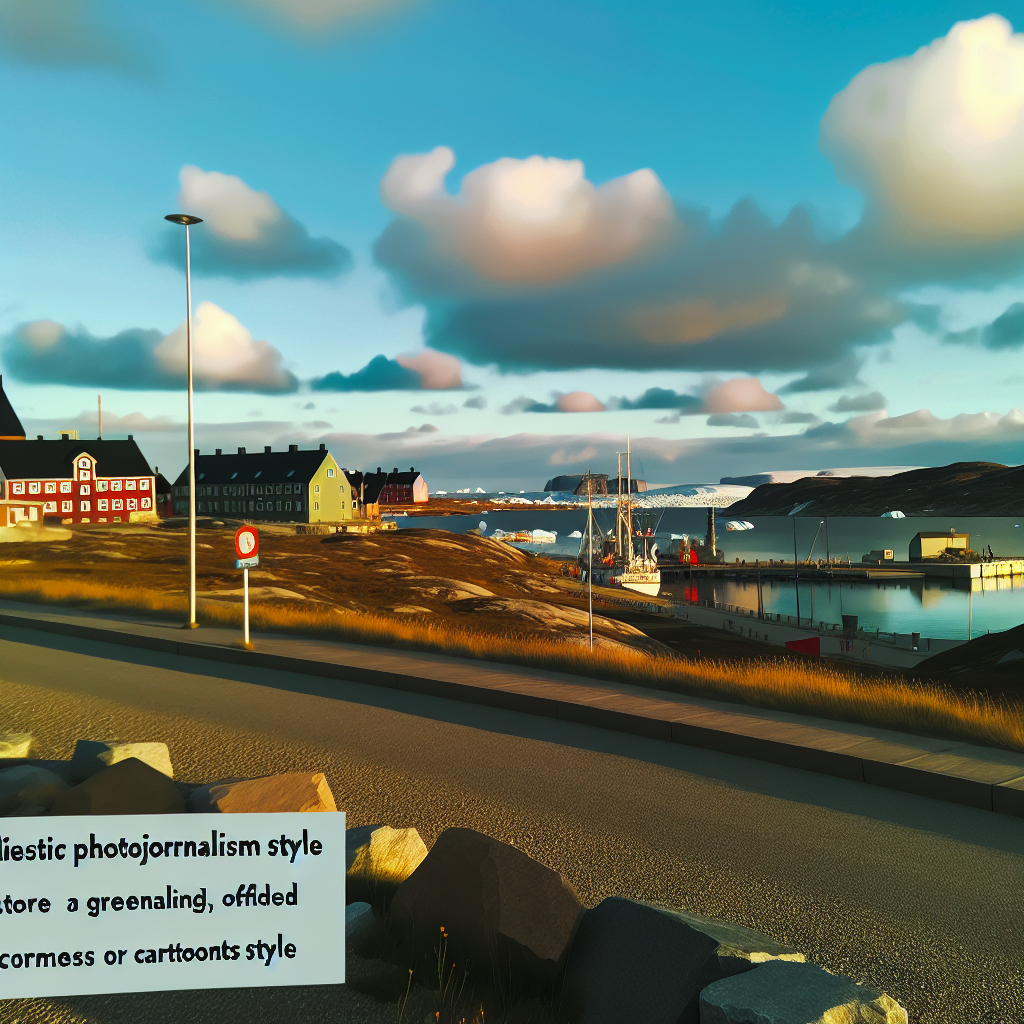
In a striking display of solidarity, Greenland and Denmark have united against U.S. President Donald Trump, choosing to momentarily set aside their complicated history. The Arctic island, long under Danish rule as a colony for over three centuries, now seeks to navigate its path as an autonomous territory.
While all major political parties in Greenland express a desire for independence, their strategies for achieving it differ. The contentious dialogue sparked by Trump’s interest in purchasing the island led to the formation of a coalition government in March of last year.
Last week, Greenland’s leaders unequivocally rejected Trump’s proposals to acquire the vast island—an idea he initially championed before stepping back following what he termed a framework agreement on Arctic security with NATO’s Secretary-General.
“Greenlanders carry a multitude of grievances stemming from Denmark’s failure to confront its colonial past,” noted Ulrik Pram Gad, a researcher at the Danish Institute for International Studies (DIIS). “However, the pressure from Trump has compelled a significant portion of the political spectrum within Greenland to temporarily set aside their plans for independence, which is inherently a long-term endeavor,” he explained in an interview with AFP.
This newfound unity has been bolstered by increasing European support, making the relationship with Denmark feel less constrictive, according to Gad.
Despite their differences regarding the route to independence, the political parties in Greenland united in March 2025 to form a coalition in response to escalating U.S. pressure, leaving only the Naleraq party, which champions a swift path to independence, in the opposition.
At the height of tensions, Greenland’s Prime Minister Jens-Frederik Nielsen reiterated a crucial point: should a choice arise between the United States and Denmark, the island would stand firmly with Denmark.
A Colonial Legacy
Trump’s discussions about a framework agreement with NATO’s chief prompted a firm reminder from both Greenland and Denmark: only they hold the authority to determine their futures.
In recent diplomatic exchanges, Greenland and Denmark have consistently projected a united front. On January 14, Greenland’s Foreign Minister, Vivian Motzfeldt, joined her Danish counterpart Lars Lokke Rasmussen in Washington for talks with U.S. Vice President JD Vance and Secretary of State Marco Rubio. A few days later, she was in Brussels for discussions with NATO’s Secretary-General, accompanied by Denmark’s Defense Minister, Troels Lund Poulsen.
Yet, beneath this facade of unity lie the deep scars of colonial history. Greenland remained a Danish colony from the early 18th century, becoming a Danish territory in 1953 and an autonomous territory in 1979—an arrangement further strengthened in 2009.
“The history is extensive and complex, reflecting various phases of relationship,” remarked Astrid Andersen, an expert on Danish-Greenlandic relations at DIIS. “Any colonial relationship inherently involves power dynamics, and grievous injustices have certainly occurred.”
Harsh Erasures
Among the historical injustices is a 1951 social experiment wherein 22 Inuit children were forcibly separated from their families, prohibited from speaking their native Greenlandic in an attempt to cultivate a Danish-speaking elite. In 2021, the few survivors were awarded compensation of 250,000 crowns (approximately €33,500).
Additionally, Denmark engaged in a decades-long campaign from the 1960s aimed at curbing Greenland’s birth rate. Thousands of women and teenagers—at least 4,000—had IUDs implanted without their consent. Prime Minister Mette Frederiksen has publicly apologized to the affected women, nearly half of whom reported being unable to conceive, and a process for compensation is currently underway.
Controversial psychological evaluations were even utilized to assess whether Greenlandic mothers were deemed fit to parent, a practice that was only ceased last year. A study from 2022 revealed that children born to Greenlandic families in metropolitan Denmark were five to seven times more likely to be placed in foster care compared to their Danish counterparts.
At present, the dialogue surrounding these difficult issues has been temporarily shelved, noted Andersen. “For now, there appears to be a consensus, with a few exceptions, that our shared adversary is Trump, and it’s essential to confront this challenge together.”
