

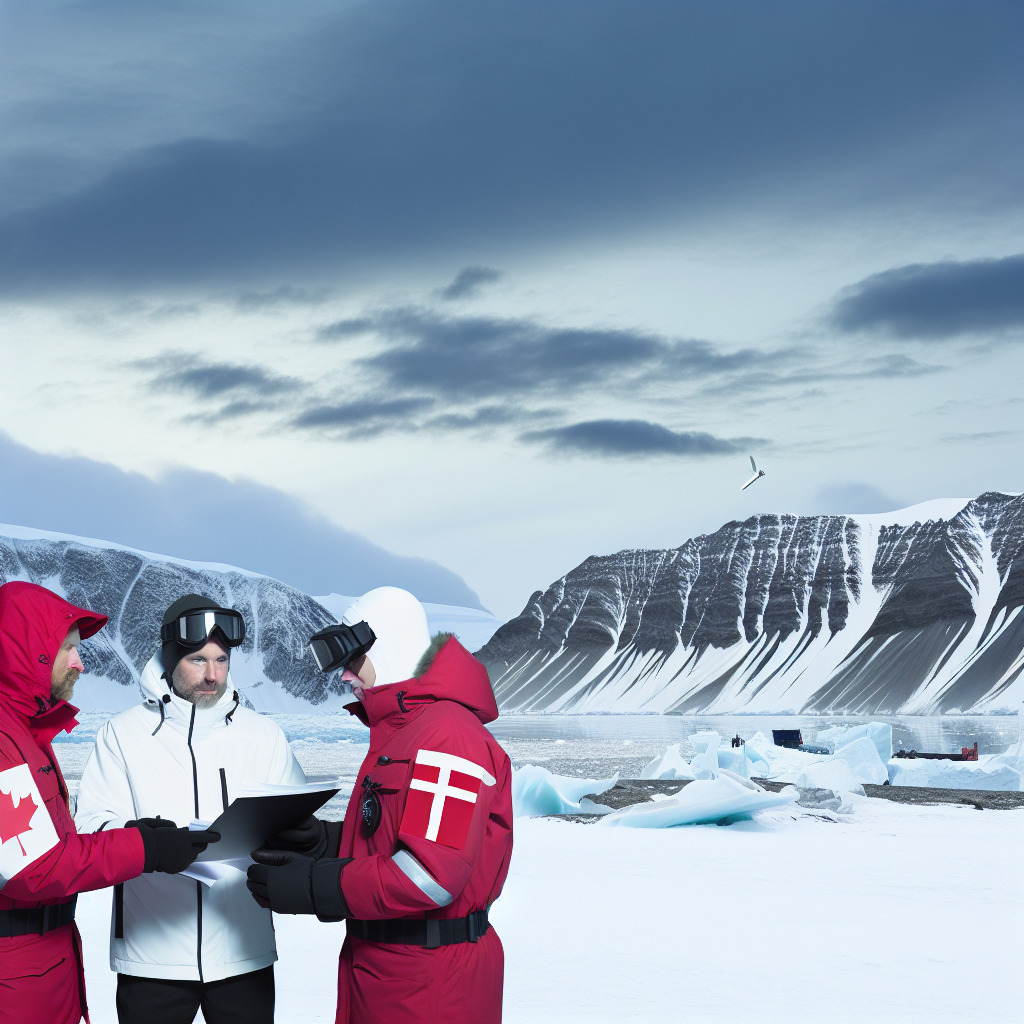
A Canadian military helicopter flies along the shoreline of Baffin Island. Canada has signed an agreement with Denmark to work more closely together on matters of Arctic security and defence.
Adrian Wyld/The Canadian Press
In a pivotal move towards enhancing Arctic security, Canada has formalized an agreement with the Kingdom of Denmark, strengthening their collaborative efforts in defense. This significant development occurred on Friday at the Munich Security Conference in Germany, where global leaders converged to address pressing international issues.
The agreement was signed by Defense Minister David McGuinty, who took the opportunity to articulate Canada’s evolving defense posture during various discussions at the conference.
“In Canada, people have finally woken up to one fundamental truth: our geography will no longer serve as our shield,” McGuinty declared during a panel focused on enhancing defense industrial cooperation.
The Munich Security Report, released just before the conference, foregrounds a critical theme—the shifting dynamics of the U.S. perspective on the international order.
Canada wants NATO’s new Arctic Sentry security mission to become permanent, Anand says
Opinion: Keeping Canada’s options open on nuclear weapons is not as simple as it sounds
This undercurrent of concern permeated discussions throughout the day, the first of three dedicated to critical conversations about security, trade, climate, and foreign affairs. Notably absent was U.S. President Donald Trump, though several prominent American figures participated, including U.N. Ambassador Michael Waltz and California Governor Gavin Newsom.
Scheduled for Saturday morning, Secretary of State Marco Rubio will take the stage, while Prime Minister Mark Carney made headlines earlier this week by canceling his trip following a tragic school shooting in Tumbler Ridge, B.C.
This newly inked agreement with Denmark, which encompasses Greenland and the Faroe Islands, underscores a shared commitment to bolster defense capabilities in the North.
A Royal Danish Navy vessel patrols near Nuuk, Greenland, in January.
Evgeniy Maloletka/The Associated Press
“Today, we send a resolute message: the Arctic is secure, and we will safeguard it,” McGuinty asserted in a written statement. The agreement not only lays the groundwork for enhanced military collaboration but also covers logistics support, training, exercises, and educational exchanges.
While in Munich, McGuinty was keen to promote Canada’s pivotal role in the establishment of the multinational Defence, Security, and Resilience Bank. He emphasized that Canada is “at the forefront” of this initiative, which aims to finance defense projects across participating nations.
In an interview, he revealed discussions with his British counterpart in Brussels, focusing on the growing interest among countries eager to learn more about the bank.
As for the bank’s future headquarters, McGuinty acknowledged that several Canadian cities are vying for the honor. However, he urged patience, stating, “Let’s first establish the bank, because it doesn’t exist yet.”
From left: Croatia’s Defense Minister Ivan Anusic, Denmark’s Defense Minister Troels Lund Poulsen, Finland’s Defense Minister Antti Hakkanen, and Canada’s Defense Minister David McGuinty at NATO headquarters in Brussels on Thursday.
Geert Vanden Wijngaert/The Associated Press
The anticipated release of Canada’s defense industrial strategy, initially scheduled for launch ahead of the conference, was postponed due to the recent tragedy in B.C. Nonetheless, McGuinty addressed the topic several times, revealing that the strategy will identify ten key capabilities for prioritization and establish a framework focusing on building, partnering, or purchasing for the nation’s defense sector.
“What can we build? If we can’t build it, who can we partner with? And when those options aren’t viable, where do we turn to buy?” he posed, highlighting a comprehensive overhaul of the Canadian Forces as a necessity.
While Prime Minister Carney’s absence is felt, his recent remarks continue to echo among the world leaders present. McGuinty received an enthusiastic response during an evening panel when he referenced Carney’s recent speech at Davos, emphasizing the importance of solidarity among middle powers.
“The depth of research, engineering, AI, quantum, and cryptography among the countries represented here in Munich is astounding,” McGuinty noted. “What we need now is collective action and collaboration.”
