

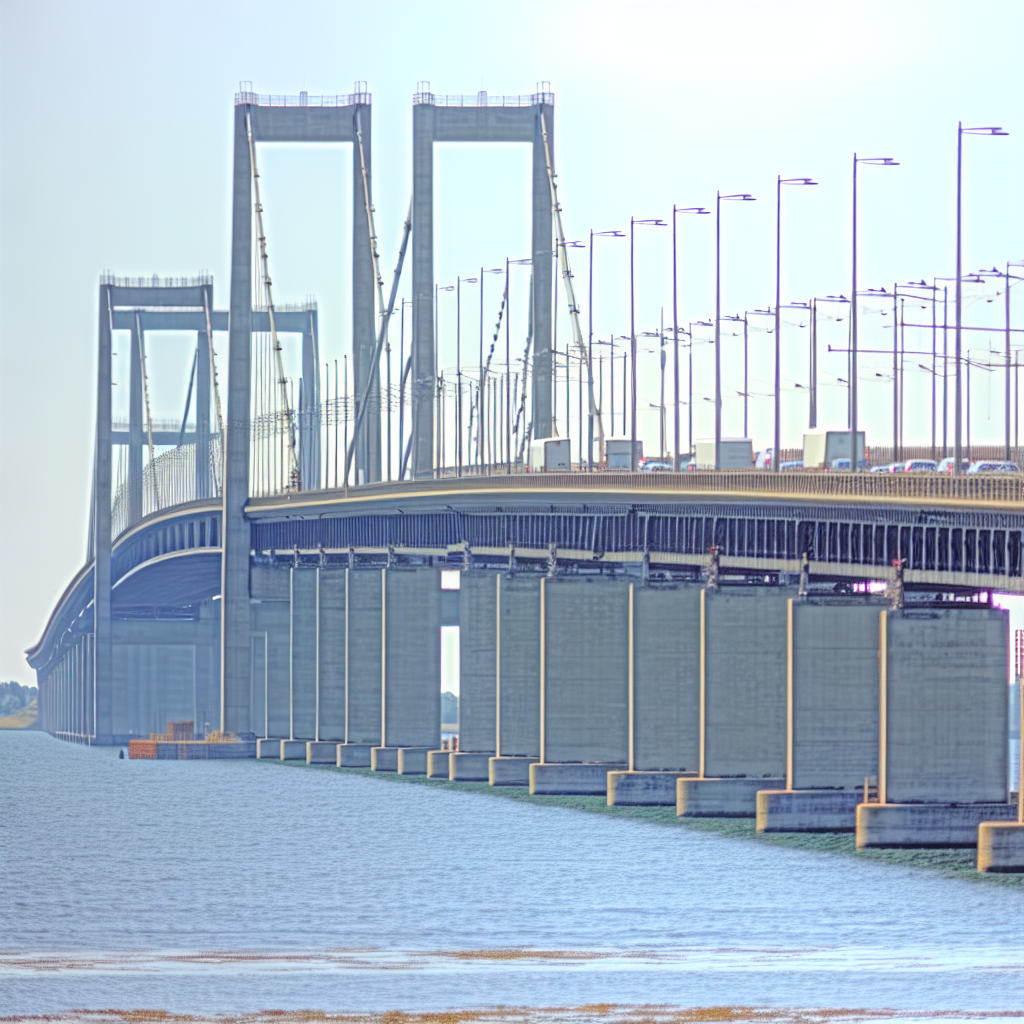
When the **Øresund Bridge** officially opened in 2000, it marked the debut of more than just an impressive steel and concrete structure spanning **7.8 kilometers over the sea**. It launched one of Europe’s largest experiments in binational urban integration, allowing two major cities from different nations—**Copenhagen** and **Malmö**—to function, for the first time, as interlinked components of a shared cross-border metropolis.
Prior to the bridge, crossing the Øresund Strait was a logistical challenge requiring ferry services bound by strict schedules. With the bridge, that journey was reduced to a smoother **15 to 20 minutes by train or car**, fundamentally changing the dynamics of work, housing, tourism, and investment between **Denmark** and **Sweden**.
A Project of Cutting-Edge Engineering and Visionary Geopolitics
Constructing the Øresund Bridge was not merely an engineering feat; it was the result of a **strategic agreement between two nations**, acknowledging that economic strength, mobility, and global competitiveness hinge on the physical integration of their territories. The project combined:
See Also Other Features
-
New technology is set to replace traditional concrete slabs, transforming civil engineering projects with lower costs, faster execution times, and increased strength.
-
An investment of R$ 25 million is establishing a new federal campus of the IFC (Federal Institute of Education, Science and Technology) in a small Santa Catarina town with just 55 residents, expected to open in a temporary location by 2026.
-
Fewer know that the longest rammed earth wall, stretching approximately 16,000 km, was constructed in Africa more than a millennium ago.
-
A R$ 254 million investment in duplicating PR-412 will transform the corridor between Paraná and Santa Catarina, introducing an overpass, a new Highway Police station, a bike path, and enhancing connectivity with the Garuva bypass in preparation for the Guaratuba Bridge.
- a cable-stayed bridge over the sea;
- a submerged tunnel near Copenhagen;
- an artificial island built solely to connect bridge and tunnel.
This unique arrangement was essential to **ensure compatibility with flight paths at Copenhagen Airport**, one of Scandinavia’s busiest. The outcome is a rare and innovative hybrid engineering solution that seamlessly integrates bridge, tunnel, and artificial island into a continuous system.
The True Scale of the Project Reshaping the Region
The statistics surrounding the Øresund Bridge illustrate why it has become a notorious symbol of continental integration:
- 7.8 km long main bridge;
- 4 km of submerged tunnel;
- 4 km of access on the mainland;
- A continuous infrastructure stretch exceeding 15 km when all segments are combined;
- two levels of traffic: road transport above and rail transport below.
This design allows for the concurrent flow of cars, buses, trucks, and high-capacity trains, establishing one of Europe’s most efficient multimodal transport corridors.
When Two Cities Became One Metropolitan Area
The urban impact was swift and profound. Professionals in Malmö began commuting to Copenhagen daily, while Danes sought residence in Sweden for its lower cost of living while working in the higher-paying Danish capital.
Thus emerged the **Øresund region**, which today stands as one of Northern Europe’s most dynamic metropolitan areas. It boasts:
- international universities;
- research centers;
- biotechnology hubs;
- headquarters of global companies;
- pharmaceutical industries;
- clean technology startups.
The bridge has effectively crafted a new binational labor market, where border barriers are reduced to mere administrative formalities.
Tourism Impacting Regional Flow
Before the bridge’s completion, tourism between Denmark and Sweden was constrained by ferry services. Since the bridge’s inauguration, visitor numbers have surged. Millions now traverse the bridge each year to:
- Experience both Copenhagen and Malmö in a single day;
- Tour castles, beaches, and historical sites on either side;
- Attend binational cultural events;
- Use the region as a launching point for exploring all of Scandinavia.
The bridge has evolved into an **international tourist artery**, enhancing local revenue and bolstering the hospitality and urban services sectors.
The Logistical Axis Restructuring All of Scandinavia
From a logistical standpoint, Øresund has transformed into a **strategic corridor for Northern Europe’s exports and imports**. Goods that once relied on lengthy routes can now flow directly between:
- Danish ports;
- Swedish industrial hubs;
- Continental rail networks.
This efficiency has reduced operational costs, shortened delivery times, and made the region particularly attractive for **European distribution centers**. International logistics hubs have proliferated around the bridge, capitalizing on its geographic advantages.
The Direct Effect on the Real Estate Market
The physical integration has fundamentally altered property values. Malmö, once characterized by significantly lower prices compared to Copenhagen, has experienced a rapid appreciation as Danes migrate across the border in search of affordable housing.
This shift has led to:
- New residential neighborhoods;
- Urban expansion initiatives;
- Growth in commercial enterprises;
- An uptick in land and real estate values.
The bridge has emerged as an **engine of international real estate**, making it commonplace for individuals to reside in one country while working in another.
A Bridge Generating Billions Annually
While figures can fluctuate, estimates suggest that the economic activity associated with the Øresund Bridge contributes significantly to the regional economy, generating **tens of trillions of euros every decade** across various sectors including:
- business;
- tourism;
- real estate;
- logistics;
- cross-border employment;
- tax revenues.
Furthermore, the tolls collected from bridge usage ensure a steady stream of income for maintenance, railway upgrades, and ongoing structural improvements.
Engineering Designed for Endurance Against Nature
The Øresund Strait is notorious for its fierce winds, strong currents, and heavy maritime traffic. Consequently, the bridge was engineered to withstand:
- Severe storms;
- Ongoing marine corrosion;
- Impacts from naval collisions;
- Simultaneous vibrations from both trains and vehicles.
Sensors continuously monitor:
- Structural shifts;
- Cable fatigue;
- Pillar tension;
- Temperature fluctuations.
This bridge stands as one of Europe’s most rigorously monitored engineering projects.
A Political Symbol of an Integrated Europe
The Øresund Bridge transcends its role as mere infrastructure; it has become a **symbol of European integration**, representing the free flow of people and collaboration among sovereign nations. In a continent still healing from historical upheavals, the bridge signifies:
- The free movement of labor;
- Academic collaboration;
- Transnational production networks;
- A regional identity that surpasses formal borders.
It embodies the principle that modern economies thrive on connectivity rather than isolation.
The Bridge as a Cultural Icon
The Øresund Bridge has gone beyond its engineering roots, embedding itself in popular culture. It has appeared in international series, documentaries, films, and thrillers, largely due to its iconic status, connecting two distinct cultures over a body of water.
This cultural dimension has bolstered its global recognition, establishing the bridge as one of Northern Europe’s most cherished landmarks.
Why It’s Considered One of the Most Important Bridges on the Planet
While there may be longer, taller, or wider-spanning bridges, few can boast:
- A direct transnational urban influence;
- An economic transformation of two major cities;
- The daily integration of thousands of workers;
- An impact on the real estate market;
- A meaningful geopolitical role in the region.
The Øresund Bridge doesn’t merely connect landmasses; it has fused the economies, labor markets, and ways of life of two entire countries.
