

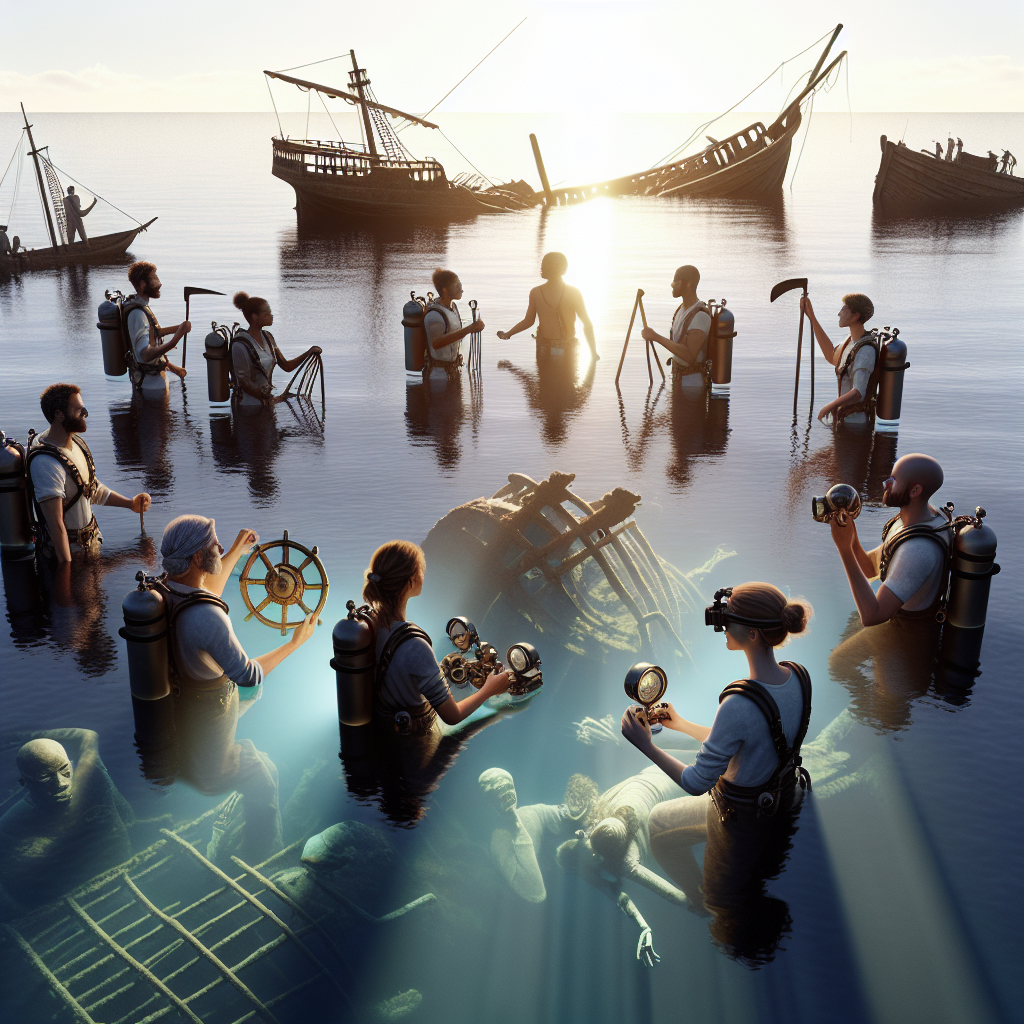
Archaeologists have made a remarkable finding off the coast of Central America: two 18th-century shipwrecks have been identified as Danish slave ships. The vessels, known as Fridericus Quartus and Christianus Quintus, lie in shallow waters near Costa Rica’s Cahuita National Park, having met their fate in 1710.
The National Museum of Denmark recently revealed that historical records indicate Fridericus Quartus was seen ablaze, while Christianus Quintus was wrecked after its anchor rope was severed. Until now, the precise locations of these shipwrecks had remained a mystery.
Recent images show divers meticulously examining the remnants of the vessels, which have suffered significant decay over the past 315 years. Interestingly, the excavation revealed that while excavated earlier this year, the true identity of the ships—originally thought to be pirate craft—was only confirmed recently.
The excavation involved collecting wood samples from the ships, along with yellow bricks believed to be part of their cargo. Researchers employed dendrochronology, or tree-ring dating, to trace the wood back to Northern Europe, specifically the western Baltic Sea, which includes regions of northeastern Germany, Denmark, and Sweden. Most notably, they determined that the timber was cut between 1690 and 1695.
The museum’s release emphasizes that the charred and sooty condition of the wood corroborates historical accounts of one ship being observed in flames. Among the artifacts retrieved were clay pipes, described as standard Dutch imports used on Danish ships. Size and design analysis of the pipes suggested they were produced shortly before the ships were lost.
Remarkably intact, the yellow bricks recovered from the wrecks were manufactured in Flensburg, intended for use in Denmark and its colonies during the 18th and 19th centuries. These findings are further supported by analyses indicating that the clay originated from specific locations near Flensburg Fjord, a hub for brick production during that era.
Following extensive evaluations at the National Museum of Denmark and the University of Southern Denmark, researchers have firmly aligned their discoveries with historical accounts. David Gregory, a marine archaeologist at the National Museum, expressed satisfaction with the clarity these findings have provided. “The analyzes are very convincing,” Gregory stated, “and we no longer have any doubts that these are the wrecks of the two Danish slave ships.”
Andreas Kallmeyer Bloch, another marine archaeologist involved in the project, noted the personal significance of these findings. He remarked, “This is undoubtedly the craziest archaeological excavation I’ve yet been part of,” highlighting both the historical impact and the emotion connected to the discovery.
As this investigation unfolds, it not only fills critical gaps in Denmark’s maritime history but also holds deep relevance for local communities affected by the legacy of slavery. The confirmation of these shipwrecks marks a pivotal moment in understanding a haunting chapter in history, providing essential pieces to a story that deserves to be remembered.
