

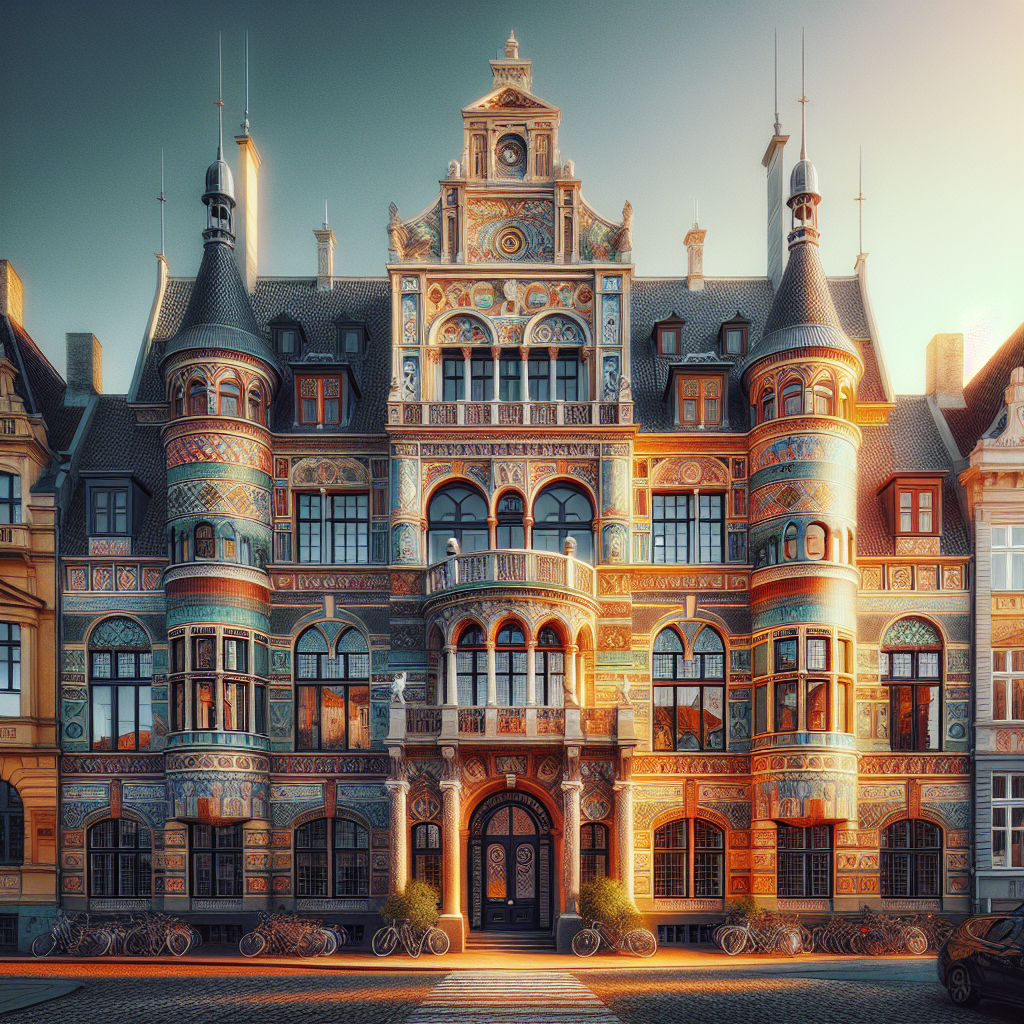
While the Nordic region is famous for its stunning capitals, the vibrant cities nestled within seem often overlooked. Aarhus, Denmark’s second-largest city, perfectly exemplifies this hidden charm.
With a history that stretches back several centuries, even predating Copenhagen, Aarhus is a delight to navigate on foot. Its streets, parks, and inviting waterfront bristle with intriguing sights and exude a sense of warmth—a sentiment captured in its endearing nickname: the City of Smiles.
Though Aarhus boasts renowned architectural marvels like the Functionalist City Hall designed by Arne Jacobsen and Erik Møller in 1942, as well as the soaring Lighthouse of 2023 by the firm 3XN, today we turn our attention to six lesser-known architectural treasures that grace this city.
Here are Aarhus’s architectural gems that deserve your attention:
Rømerhus
1895; renovated 2014-2017
Named for Ole Rømer, the prominent 17th-century astronomer from Aarhus, Rømerhus shines brightly along two of the city’s main thoroughfares—the Aarhus River and the lively Strøget pedestrian street.
Architect Sophus Frederik Kühnel initially planned the site, though it remains uncertain if he executed the final design that was completed in 1895.
Originally conceived as a Renaissance Revival structure, Rømerhus served a variety of purposes, blending retail and light manufacturing.
As time wore on, the building lost some of its allure; the river was obscured by a roadway in the 1930s, and alterations were made to its façade and roof.
However, a revitalization began to take shape when the Strøget was pedestrianized in the 1970s, the river was uncovered in the 1990s, and fashion powerhouse Bestseller acquired the building.
In partnership with its tenant, E+N Arkitektur A/S, Bestseller carefully restored historic elements of the structure while modernizing its interior to accommodate both shopping at its base and upgraded office spaces above.
BESTSELLER RØMERHUS
St. Clemens Torv 8
8000 Aarhus
Volmerhus
1898
Just three years after Rømerhus, the elegant Volmerhus, designed by architect Rudolf Frimodt Clausen, emerged as a symbol of Aarhus’s economic ascent as the 20th century loomed. Developed by local baker Peer Jensen, who proudly operated a pastry shop on the ground floor, the building’s historicist style mirrored Jensen’s ambitious vision for his venture.
In the 1910s, Jensen sold the establishment to Jens Emery, who rebranded the café in his own name. This seemingly insignificant change turned out to be fortuitous, as Emmery’s patisserie thrives in the building to this day.
Though now part of a larger corporate chain, this location retains its legacy as the original Emmery’s.
Emery’s
Guldsmedgade 24
8000 Aarhus
Aarhus Theatre
1900; various restorations and alterations 1953-2011
In the late 1890s, a group of influential Aarhus residents commissioned architect RF Clausen, designer of Volmerhus, to create a theater worthy of the city’s growing stature. Following a site change to a city-owned plot near the Cathedral, Royal Building Inspector Hack Kampmann, in collaboration with artist Karl Hansen Reistrup, produced new plans.
The Art Nouveau-style Aarhus Theatre opened its doors on September 15, 1900, to widespread acclaim and pride. Its richly adorned façade showcases a mosaic designed by Hans Tegner, bringing to life characters from the comic play “Maskerade” by Danish playwright Ludvig Holberg. Below, a frieze of majestic eagles—drawn from Viking artifacts unearthed during the site’s excavation—adds to its charm.
Other striking features include a dramatic dragon figure perched above the pediment and masks of comedy and tragedy, inspired by art from the House of Faun in Pompeii. Many of these decorative elements were crafted by the renowned Kähler ceramics factory.
Since the 1950s, the theater has seen numerous updates by CF Møller Architects. Today, it houses four performance stages, alongside support spaces such as Café Hack, lovingly named after its original architect.
Aarhus Theatre
Teatergaden 1
8000 Aarhus
Aarhus Court and Detention Centre
1906; renovation 2014-2016
With the rapid growth of Aarhus came significant challenges, including the pressing need for a modern courthouse and detention center in the early 20th century. An architectural competition in 1902 culminated in the selection of architects Knud A. Ludvigsen and Julius Hansen, who completed the project in 1906.
The duo enlisted Karl Hansen Reistrup, the same artist from the theatre project, to enrich the building with decorative elements. The façade, characterized by National Romantic masonry, features lion sculptures, ornate clocks, and law-themed bas-reliefs.
Time hasn’t diminished the splendour of this structure, which continued serving as a detention center until recent renovations from 2014 to 2016 by H+ Architekter A/S. Today, though it has shed its previous function, the building proudly holds the title of “Danmark’s skumbreste tinghus” (Denmark’s most beautiful courthouse).
THE COURT AND ARRESTHUSET, now the COURT OF AARHUS
Vester Allé 10
8000 Aarhus
New Jutland Market Town Credit Association
1912
While often regarded as Denmark’s second city, Aarhus also stands as the first city of Jutland, the mainland portion of Denmark. This pivotal status is encapsulated in the New Jutland Market Town Credit Association, constructed between 1910 and 1912 as the headquarters for a regional credit union.
The building’s façade lists the names of various market towns across Jutland, adorned with the historic Jutland coat of arms. Designed by architects Eggert Christoffer Achen and Thorkel Møller, it artfully combined historical eclecticism with Art Nouveau elements. Situated near the Aarhus River, the building features an almost pastoral landscape.
This establishment served as a bank until 2019, having transitioned into an outpost of Danske Bank amid a series of mergers. Today, it is proudly occupied by Vertica, an Aarhus-based e-commerce company—a fitting homage to its Jutland roots.
NEW JYDSKE KJØBSTAD-CREDITFORENING, now VERTICA
Åboulevarden 69
8000 Aarhus
Aarhus School of Architecture
2021
Not only does Aarhus boast a rich tapestry of historic architecture, but it also claims a stake in the forefront of 21st-century design. While new buildings along the waterfront capture much of the spotlight, the Aarhus School of Architecture, completed in 2021, stands as a testament to the city’s architectural evolution right in its heart.
A collaborative venture between architectural firms Adept and Vargo Nielsen Palle, this building links the city’s post-industrial urban landscape. On one side, a conventional four-story façade seamlessly integrates into the existing urban fabric. Yet, on its reverse side, the structure gracefully descends to Institute for (X), a former railroad yard reimagined as a vibrant cultural and entrepreneurial hub.
The Architecture School is defined by principles of flexibility and transparency, featuring ground-floor public spaces where visitors are welcome to explore student projects. After appreciating Aarhus’s historic architectural fabric, take a moment to witness where the City of Smiles is headed next.
AARHUS SCHOOL OF ARCHITECTURE
Exners Plads 7
8000 Aarhus
Craving more hidden architectural gems? Delve into our articles exploring Stockholm, Copenhagen, Malmö, and Oslo.
