

IN the reflective surface before me, I don an extravagant pair of golden pantaloons, visible only to my own eyes. Nearby, children engage in imaginative play as mermaids in a rock pool, while in an adjacent room, a talking pea resides behind glass, flanked by an impressive stack of mattresses. Welcome to the enchanting world of Hans Christian Andersen (1805-1875), one of the most cherished literary figures of the 19th century. Here I am in Odense, located on the island of Fyn—occasionally anglicized as Funen—delving into Andersen’s lasting legacy in his hometown, a century and a half after his passing, in hopes of uncovering a few fairytales of my own.
At the heart of the city lies HC Andersen’s House, a museum dedicated to the beloved author, intricately intertwined with his childhood home. Niels Bjørn Friis from Museum Odense notes that previous versions of the museum paid scant attention to Andersen’s rich storytelling. While his life was chronicled, tales like “The Ugly Duckling,” “Thumbelina,” and “The Little Mermaid” were noticeably absent. For those who journey to Odense seeking the enchantment of storytelling, this oversight left much to be desired.
The recent redesign of Odense’s city center, particularly the rerouting of a key roadway, provided an excellent opportunity to revamp how the city honors its most illustrious resident. A prestigious architecture competition saw the Japanese firm Kengo Kuma and Associates take the lead, with a fresh perspective embedded in their design. The striking timber-clad museum, characterized by interconnected spiraling spaces, opened to much acclaim in 2021. “Our aim was to create a space that doesn’t just speak about Andersen, but embodies his essence,” Friis explains, “delivering humor, irony, and layered perspectives.” Even the gardens reflect this vision: “It’s a space for wanderers and giants alike, artfully designed to evoke a sense of smallness,” he continues, achieved through thoughtful planting that plays with height, scale, and winding pathways.
Andersen himself penned two and a half autobiographies, often contradicting his own narratives. This complexity resonates throughout HC Andersen’s House, where the voices of friends and excerpts from letters intermingle to pose gentle challenges to the author’s own tales. “Andersen serves as the guide, but he’s not entirely trustworthy,” states Friis. The result is an engaging whirlwind journey through Andersen’s life, creative thought, and cherished stories, designed to entertain both adults and children with an additional fantastical basement nook, Ville Vau, for younger visitors.
Stepping back into the vibrant real world, Odense presents an inviting tableau of cobbled streets and colorful wooden houses. The spirit of Andersen permeates the city: traffic lights depict the writer in his iconic top hat, brass footprints guide visitors on a self-directed Andersen walking tour, and sculptures echo his themes. Each August, this dedication culminates in the annual HC Andersen festival, celebrating the author’s legacy through art, dance, theater, and music.
This year, the week-long event boasted an astonishing 500 shows, with the majority offered free of charge. As I wander Odense, I encounter painted stilt-walkers, whimsical monsters, and an Andersen impersonator sharing stories. The festival showcases spoken-word pieces that resonate with feminist themes and culminates in breathtaking performances featuring acrobats gracefully descending from the town hall, suspended from cranes. Still ahead are lectures, family art workshops, and the city’s annual Magic Days festival, which seeks to expand the storytelling legacy beyond Andersen’s own.
As is common throughout Denmark, cycling serves as the most enjoyable means to navigate Odense. A “cycling highway” meanders through the city center, where I set off from Hotel Odeon to visit a free harbor-side swimming pool and loop out to Stige Ø, a small island linked to the mainland. Here, locals gather to picnic after work or take a moment to fish, paddleboard, or swim.
My culinary adventure unfolds at Restaurant Under Lindertræet, where the menu draws inspiration from Andersen’s tales. During my visit, the charming proprietor, Nils Palmqvist, shares English translations of selections from the poem “Denmark, My Native Land” as he delights us with each course. This pattern repeats throughout my stay in the city, where residents—fondly known as fynbo—have a penchant for storytelling that feels woven into the very fabric of life here.
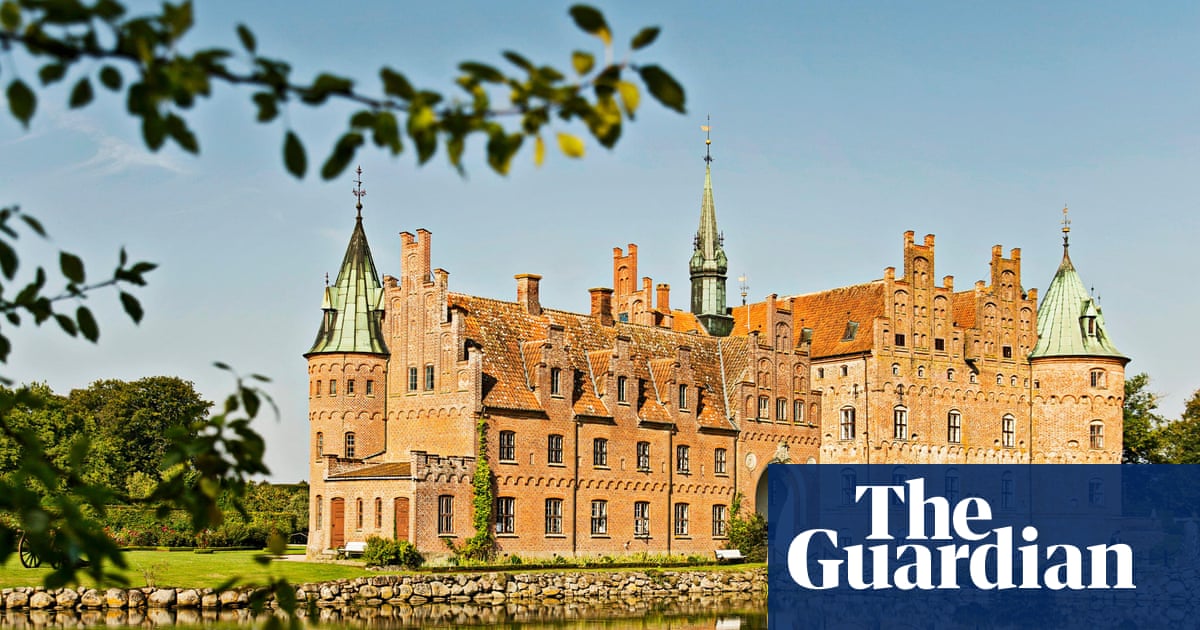
No visit to a fairytale locale would be complete without a castle, and Funen proudly boasts 123 castles and manor houses. Venturing beyond Odense, I find myself at Egeskov Castle, celebrated as Europe’s best-preserved Renaissance water castle. While much of it welcomes visitors, Egeskov remains a family home, belonging to Count Michael Ahlefeldt-Laurvig-Bille and his wife, Princess Alexandra zu Sayn-Wittgenstein-Berleburg. I can’t help but wonder if she too can feel a pea through a pile of mattresses. The couple is often seen meandering amidst the vast landscaped gardens and children’s play spaces, engaging with visitors.
From Valdemars Castle, I board the MS Helge, a charming wooden ferry launched in 1924. The ferry transports visitors around the stunning South Funen archipelago, a coastline recently designated as a UNESCO Global Geopark thanks to its remarkable ice age landscape. My journey takes me to Svendborg, where I rent a bike from South Funen Bicycle Rental. Today, I’m cycling alongside Mette Mathiasen from Destination Fyn, the visionary behind the extensive 410-mile (660 km) castles route winding through Funen. We explore a 21-mile section that traces the coastline toward the village of Åbyskov and Elsehoved beach, passing turreted castles, splendid manors, and tranquil stretches of coastline. Country lanes lined with overhanging hedgerows burst with ripe blackberries, making the ride all the more delightful. While the southern landscape introduces some rolling hills, there are ample quiet trails and the option of e-bikes, ensuring it’s a gentle ride for everyone.
As day turns to dusk, I cross a moat to arrive at my final castle of the day—Broholm Castle. With a captivating 700-year history and a treasure trove of ghost stories, it also served as a frequent retreat for Andersen, appearing in his 1837 novel Only a Fiddler. Andersen’s own journey from childhood poverty to worldwide acclaim was a remarkable tale in itself, and my own adventure through Funen—filled with castles and vibrant characters—has been no less surprising.
This experience was made possible by Visit Denmark and Destination Fyn. Accommodation at Hotel Odeon starts from 1,100 kroner (£128) B&B, while Broholm Castle offers doubles from 1,695 kroner.
