

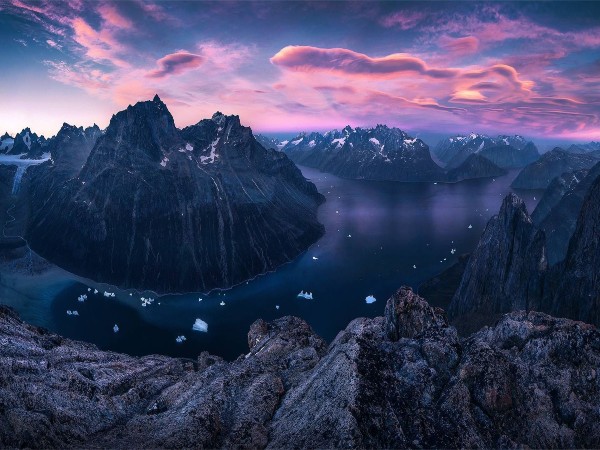
Greenland, a self-governing province of Denmark, stands as the world’s largest island, adorned by its vast ice sheet—one that stretches up to 3 kilometers (about 1.9 miles) thick, 2,500 kilometers (1,553 miles) long, and as wide as 1,000 kilometers (600 miles). This massive expanse covers a staggering 81 percent of the island and holds about 10 percent of the world’s freshwater. The weight of this colossal ice sheet has even caused the central landmass to sink more than 300 meters (1,000 feet) below sea level.
The ice sheet is not static; it is a living entity that undergoes constant movement, recycling itself in cycles that can span up to 100,000 years at its edges. Enormous glaciers push outward toward the coastline, where they often break apart to form towering icebergs. The Sermeq Kujalleq glacier, located on the west coast, makes its way to the sea through the breathtaking Ilulissat Icefjord, advancing at an impressive rate of 19 meters (65 feet) per day. However, this once-mighty glacier is now retreating dramatically—by 15 kilometers (9 miles) in just four years—and serves as a poignant reminder of the impacts of climate change.
The essence of ice runs deep through Greenland’s culture, ecology, and climate. Communities have thrived along its ice-free margins for over 4,500 years. In the southern and western regions, the landscape is dotted with hundreds of significant ruins that reflect a rich tapestry woven from Inuit, Viking, and contemporary Danish influences. Visitors can immerse themselves in the vibrant modern Inuit culture in Qaanaaq, where traditional drum dancing, singing, and kayak demonstrations beckon. For the adventurous, dog sled trips offer opportunities to hunt or fish alongside walrus, seals, musk oxen, and expansive bird colonies. Here, you can revel in nature’s wonders, from the midnight sun to the mesmerizing dance of the Northern Lights (Aurora Borealis), especially during the peak seasons.
In this ethereal land, where ice encapsulates both land and sea, the cultural heritage is intricately tied to the hunter-gatherer lifestyle and the majestic polar bear. Yet, as global warming looms, the fate of countless individuals around the globe hangs in the balance, intricately linked to the future of the Greenland ice sheet.
When to Visit
To make the most of your experience, plan your visit between May and July when daylight prevails for 24 hours. For an encounter with polar darkness, consider the months of November through February. The Northern Lights put on their most dazzling displays typically in September and March.
How to Reach
Your journey to Greenland can begin with flights from Copenhagen or Baltimore to Kangerlussuaq (west), or from Reykjavik directly to Nuuk (southwest) or Kulusuk (east), with additional routes from Copenhagen to Narsarsuaq (south). Once in Greenland, Kangerlussuaq serves as a hub for domestic flights, and visitors can also navigate the majestic west coast via scheduled ferries or helicopters. Cruise ships frequently dock at Ittoqqortoomiit, offering another means to explore the captivating landscape.
Highlights
- Embark on whale safaris from Nuuk in the summer, where humpback and minke whales gather in abundance. You might even glimpse fin, blue, sperm, and pilot whales, along with the elusive narwhal.
- Explore the Viking longhouse, Tjodhilde’s Church, and the extensive Brattahlid ruins at Qassiarsuk, near Narsarsuaq—the very site where Leif Eriksson set sail for Newfoundland.
- Take a sailing excursion amidst the icebergs calved by the Ilulissat Icefjord, where the low-hanging midnight sun casts golden light on 100-meter (330-foot) towers of ice.
- Experience the thrill of a zodiac or snowmobile ride along the edge of the sea ice in the vast National Park that encompasses northeastern Greenland—your best chance to encounter a polar bear.
- Relax in the soothing hot springs of Uunartoq Island in southern Greenland, where a stone-dammed pool is framed by wildflowers and a breathtaking panorama of mountains and drifting icebergs.
- Marvel at some of the 60 breeding and 170 migratory bird species that call this unique environment home, including the white-tailed eagle, peregrine, and gerfalcon.
Important Note
The Icelandic Sagas tell of Norse settlers arriving in Greenland in 982. The last historical reference regarding the Viking population comes from a wedding documented in Hvalsey Church in Qaqortoq in 1408, a record housed in the Vatican archives in Rome.
