

As summer holidays approach, many travelers from the UK are turning their gaze northward, seeking refuge from the rising temperatures and overstretched tourist hotspots in Southern Europe. With concerns about overtourism and extreme heatwaves, a wave of interest in cooler, less crowded destinations is emerging.
According to eDreams Odigeo, parent company of well-known online travel brands Opodo and eDreams, searches among UK users for trips to Sweden in July and August have surged by 27 percent compared to the same time last year. Neighboring countries like Norway, Finland, and Denmark have also seen a notable uptick in interest, with increases ranging from 11 to 16 percent. Adding to this trend, Intrepid Travel has reported a striking 22 percent rise in bookings for Iceland and an impressive 41 percent for Estonia this summer.
Yet, despite the evident shift in travel patterns, there remain plenty of serene beaches where milder climates await those willing to venture off the beaten path.
Gateway to the Danish Wilderness – Vorupør, Denmark
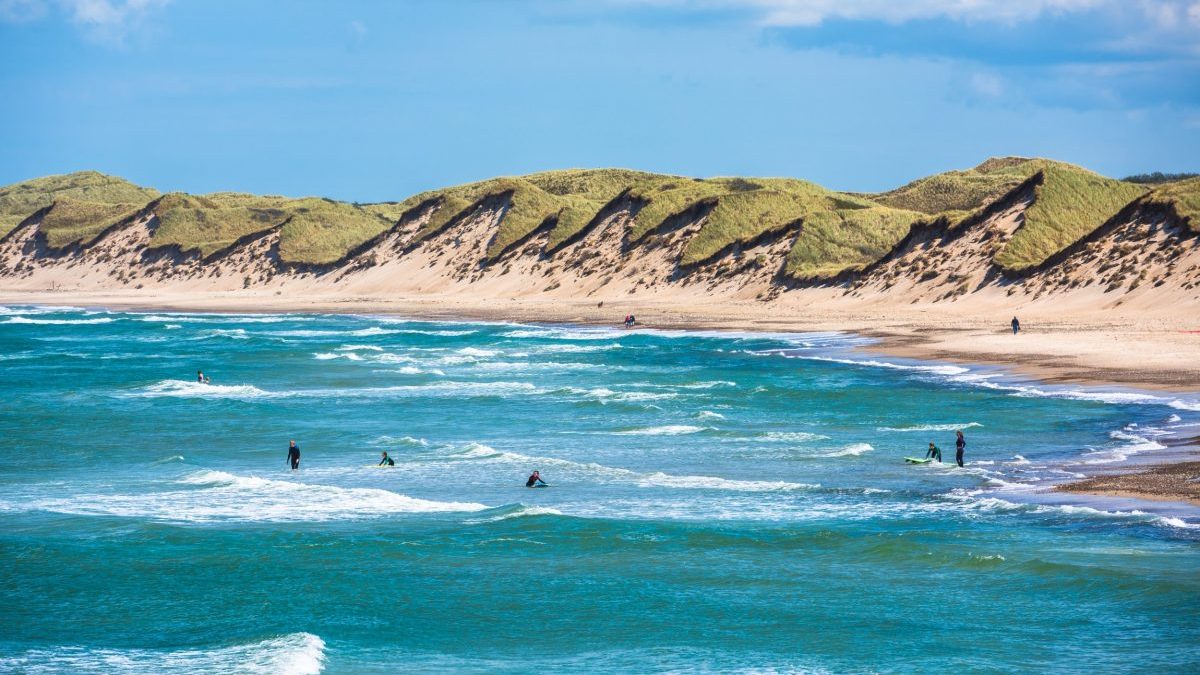
Nestled in north-west Jutland, Vorupør lies at the heart of Thy National Park, Denmark’s most expansive wilderness. This beach town is refreshingly untouched by modern development, its charm enhanced by traditional fishing boats being hauled ashore by winch—a nod to its nautical heritage. Vorupør is home to one of Denmark’s few tidal swimming pools, equipped with a wheelchair ramp, and is part of the surf-friendly stretch known as the “Cold Hawaii” coast.
While Vorupør might be considered bustling in comparison to the more desolate areas of the Thy region, it remains delightfully tranquil compared to the Mediterranean resorts. Visitors should not miss the national park’s breathtaking landscapes of heath-covered dunes, which extend for about 34 miles beyond the village.
Reaching Vorupør is straightforward: trains from Copenhagen connect to Sjørring, from where a bus will take you to your destination. Alternatively, a scenic drive spans 256 miles from the capital or a shorter 110 miles from Billund Airport. The boutique hotel Vø Drop Inn, conveniently located near the beach, offers doubles starting from £96, including breakfast. For more information, visit vodropinn.dk.
Edge of the Archipelago – Naantali, Finland
With its historic center showcasing 300-year-old wooden houses, Naantali is a captivating introduction to the Archipelago Sea, a remarkable area of the Baltic hosting the world’s largest archipelago. Known as one of Finland’s oldest towns and original holiday resorts, Naantali has earned the affectionate title of the “Sunshine Town of Finland,” offering relatively pleasant weather with summer highs often around 20°C.
For an unforgettable experience, consider a boat trip to explore some of the 50,000 islands, or visit Moominworld, a beloved theme park inspired by Tove Jansson’s cherished characters. And, of course, make time to linger at the beach.
Several inviting options are within reach, including the popular Nunnalahti, a gently sloping sandy area near the bridge to Moominworld. For a quieter alternative, check out Kailon uimaranta (Kailo Beach), a peaceful stretch flanked by trees on Kailo Island, a location for Moominworld but outside the paid attraction.
From Helsinki, you can choose between a 115-mile drive or a train ride to Turku, followed by a bus to Naantali. Access Nunnalahti and Kailon beaches via Nunnakatu, situated about a mile northwest of central Naantali. At Naantali Spa Hotel, located on a headland with direct beach access, doubles start at £154 (see naantalispa.fi).
UNESCO-listed Dunes – Curonian Spit, Lithuania
In the past, the rapidly changing dunes of the Curonian Spit would often bury settlements. However, clever locals took action in the 19th century, planting pine forests that stabilized the shifting sands and enhanced the region’s natural beauty. Today, this 61-mile stretch of land, flanked by beaches and shared between Lithuania and Russia, is a UNESCO-protected landscape that boasts the world’s highest moving dunes.
Your base should be the stylish, artistic resort town of Nida, where the Blue Flag beach, part of which is designated for naturists, is often heralded as the finest sandy stretch in the Baltics.
Nida has attracted many turn-of-the-20th-century Expressionist writers and artists, including the literary great Thomas Mann. The town is also adorned with colorful pennants and hosts a variety of festivals throughout the summer, celebrating music, literature, and cinema, including a jazz fest and the Thomas Mann Festival in July.
The town marks the starting point of the Baltic Coastal Hiking Route, which also traverses Peraküla.
Reaching Nida involves a 166-mile drive from Kaunas, Lithuania’s second city, or you can catch a train to Klaipeda, followed by a bus ride. The best stretch of beach is about a mile and a quarter northwest of Nida’s city center. Prie Mariu, a quaint half-timbered hotel with beach access, offers doubles starting at £59 (details at priemariunida.lt).
Scandinavia’s Best Beach Bar – Stokkøya, Norway
Though reaching the island of Stokkøya requires a journey along winding roads—150 miles from Trondheim—it is well worth the effort for beach lovers. Here, you’ll find Hosnasand, arguably the finest beach bar in all of the Nordics, nestled at the northern edge of the beach.
Hosnasand is a golden bay on Stokkøya’s west coast, where sandy shores gently slope into clear waters, backed by lush, green hills. Restaurant Strandbaren, with its stunning floor-to-ceiling glass design and stepped terrace, allows diners to savor local fare while gazing at spectacular sea views.
The drive from Trondheim to Stokkøya takes just over three hours, with a bridge connecting the two. Stokkøya Strandhotell in Hosnasand provides an eco-chic getaway with beachfront views, offering doubles starting from NOK 1,950 (£145) for bed and breakfast (visit stokkoy.no for more information).
Royal Retreat – Öland, Sweden
This slender, bridge-linked island off Sweden’s southeast coast is a storied holiday haven for Swedes, though it remains relatively undiscovered by foreign travelers.
In the vicinity of Böda village in the northeast, Böda Sand boasts one of Sweden’s longest beaches, a pristine expanse of 12.5 miles of white sand and glistening shallow waters that can easily rival Caribbean paradises—without the hefty price tag.
Öland also enjoys one of Sweden’s most pleasant climates, with July and August lows averaging in the early 20°Cs; the northern region near Böda typically enjoys the island’s most temperate weather.
The area was once a royal hunting ground, offering expansive wooded landscapes interwoven with hiking trails. The island’s rich history ranges from Iron Age remnants to a baroque castle, which is situated near the summer residence of the Swedish royal family. The southern plains of Öland, known as Stora Alvaret, are emblematic of traditional farming culture and hold UNESCO World Heritage status.
From Stockholm, take the train to Kalmar (a journey of just over four hours), where you can easily hire a car for your drive across the bridge to Böda. Alternatively, it’s a 313-mile trip directly south from Stockholm to Böda Hotell, a charming early-20th-century railway hotel just a mile from the beach, with doubles starting from £132 B&B (see bodahotell.se for details). Several campsites along the beach, such as Bödagårdens Camping, offer tent pitches starting from £20 per night (find more at camping.se).
Solitude and Singing Sands – Peraküla, Estonia
Estonia’s coastline is rich with inviting beaches, stretching over distances greater than the country’s land borders. Yet, what sets west coast Peraküla apart is its astonishing seven-and-a-half miles of blonde singing sand—so fine it squeaks or “sings” underfoot.
There are two main beaches here: Nova Rand and Keibu Rand, both of which offer unspoiled stretches of paradise. Keep in mind that these are also unguarded, so caution is warranted.
To reach the beach, you’ll need to venture through pine forests. Many locals enjoy foraging for berries—best found between July and September—adding to the charm of the experience. This picturesque setting forms part of the Baltic Coastal Hiking Route, which connects Nida to Tallinn.
From Tallinn, a drive of 50 miles west will take you to Peraküla. Marika Puhkeküla is a tranquil resort village with self-catering cabins tucked into the forest, with rates starting from £42 per night for two guests (for more information, visit marikapuhkus.ee). The cabins are located about a mile and a half from Keibu Rand and just a bit farther from Nova Rand.
Black Sands and Sea Stacks – Reynisfjara, Iceland
A beach holiday along Iceland’s south coast is undeniably unique—a stunning getaway above the 60° latitude line, though not one typically associated with sunbathing.
Reynisfjara stands out with its dramatic black sands, towering sea stacks, and mesmerizing rock formations, including the lava-crafted Hálsanefshellir cave.
It’s important to note that both the cave and the beach can be perilous during stormy weather, so joining a guided tour is advisable. Arctic Adventures offers a “south shore adventure” tour for $137 (£102) per person, which highlights Reynisfjara among other breathtaking sights.
The beach is steeped in folklore; legend has it that two trolls were turned to stone by the sun while trying to haul a ship ashore, thus forming the Reynisdrangar sea stacks.
After soaking in the coastal wonders, consider a visit to Sólheimajökull glacier, easily accessible by road, approximately 40 minutes from Reynisfjara. Other nearby attractions worth exploring include the spectacular waterfalls of Skogafoss (just 35 minutes away) and Seljalandsfoss (55 minutes distant).
Located near the village of Vik i Myrdal, the Farmhouse Lodge offers a variety of accommodations, from single rooms to glamping tents. Doubles start from €250 (£214), and Vik i Myrdal lies about three hours’ drive from Keflavik Airport.
