

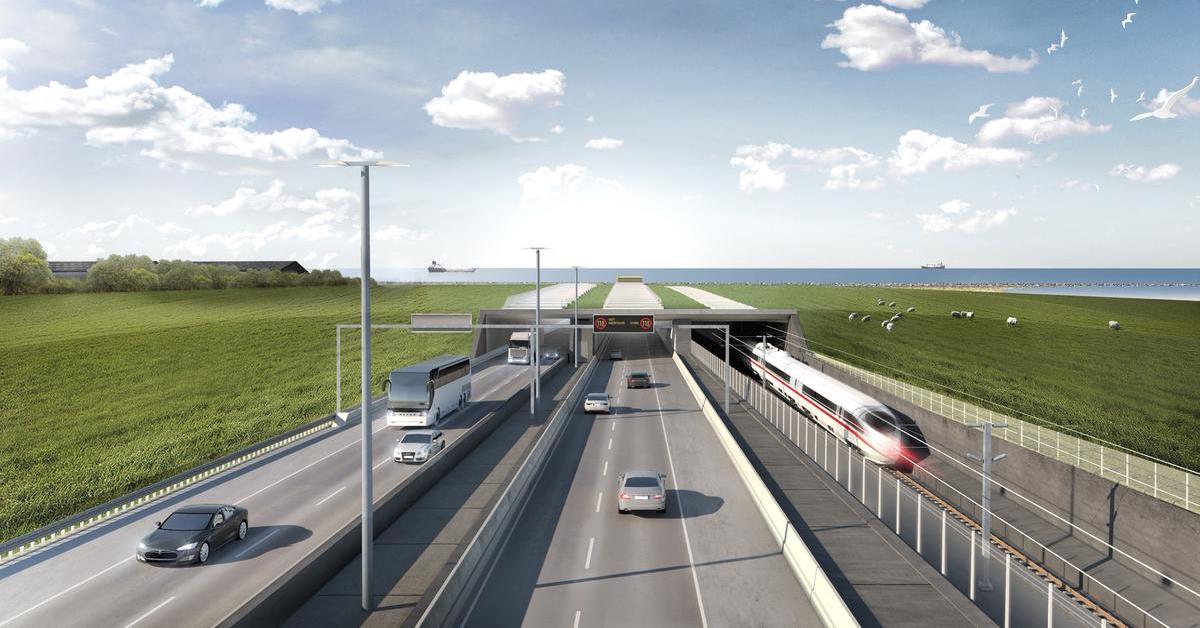
When completed, the Fehmarnbelt tunnel will hold the title of the world’s longest immersed tunnel, linking Denmark and Germany in an ambitious engineering feat. As of now, a significant milestone has been reached: the dredging of the trench for this 18-kilometer (11.1-mile) tunnel is now half complete.
Videos by TravelAwaits
“We are, of course, delighted that the work is progressing on schedule,” commented Henrik Vincentsen, CEO of Femern A/S, the Danish developer overseeing the project, in a recent statement to Ground Engineering.
“Our focus is now on the project’s next goal. It’s crucial for us that the Fehmarnbelt tunnel is constructed as sustainably as possible,” Vincentsen elaborated. “Whenever feasible, we and our contractors aim to identify opportunities to enhance the project with environmental considerations in mind, contributing our expertise to future infrastructure initiatives.”
The tunnel will forge a connection between Rødbyhavn on the island of Lolland in Denmark and Puttgarden in northern Germany. Once opened in 2029, it will host a four-lane highway alongside two railway tracks.
Dredging operations commenced in July 2021 and are slated for completion in 2024. In total, about 19 million cubic meters of soil will be excavated, with plans to repurpose this material to create new natural and recreational spaces, as explained by Femern A/S.
The Tunnel’s Benefits
The concept of connecting Denmark and Germany via a bridge or tunnel has been on the table for years, but it was only after a decade of planning that construction of the Fehmarnbelt tunnel finally kicked off.
Once finished, the tunnel will significantly ease commuting. Travelers will be able to journey between Rødbyhavn and Puttgarden in just 7 minutes by train or 10 minutes by car—an approximate savings of one hour that currently goes to ferry transport, according to Femern A/S.
Beyond convenience, the Fehmarnbelt tunnel is set to play a crucial role in Europe’s shift toward greener transportation. By establishing the fastest and most direct route, it will contribute to a reduction in CO2 emissions while alleviating congestion on existing roads and railways.
Moreover, Denmark is also developing rail connections to and from the tunnel, designed for electric trains that will travel at speeds reaching 200 kilometers (about 124 miles) per hour. This not only promises quicker travel times but also reduces reliance on buses, further cutting down on carbon emissions.
A Unique Approach
In contrast, the 50-kilometer (31-mile) Channel Tunnel linking England and France was constructed using a drilling method, whereas the Fehmarnbelt tunnel will utilize immersed pre-built sections.
The construction process begins with the establishment of tunnel portals in both Denmark, near Rødbyhavn, and in Germany, close to Puttgarden. These portals will seamlessly connect the tunnel’s highway and railway to the existing infrastructure in each country.
Following this, a total of 79 standard elements and 10 specialized sections will be fabricated. Each standard element measures 217 meters long (nearly 712 feet) and weighs over 81,000 tons.
Once each section is fitted with waterproof bulkheads, they will be towed into position and lowered to the seabed by cranes. After being set in place, these elements will be securely connected.
Upon completion of the assembly, the project will shift to what Femern A/S refers to as “technical and mechanical installations.” This phase encompasses everything from laying railway tracks and highway lanes to implementing ventilation systems, cameras, and communication technology.
The entire endeavor is on track for completion by mid-2029, marking a new chapter in cross-border travel and sustainability in Europe.
For more insights into fascinating bridges you can drive across, be sure to read:
