

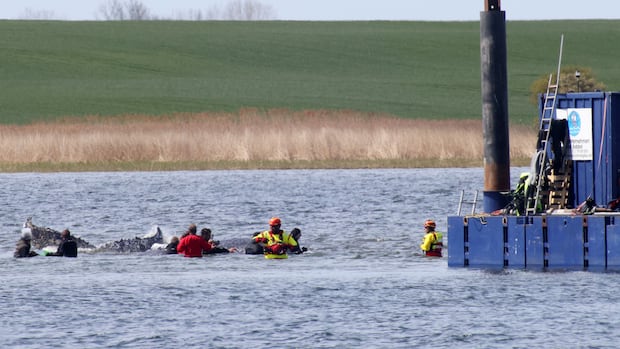
Humpback Whale Found Dead Near Danish Island Identified as Recent Rescue Subject
A humpback whale discovered deceased this week off the coast of Anholt, a small island in Denmark, has been confirmed to be the same animal that was part of a dramatic and controversial rescue operation just two weeks earlier. This whale had repeatedly stranded itself along Germany’s Baltic Sea coast, sparking widespread concern and rescue efforts, authorities announced on Saturday.
The whale’s lifeless body washed ashore on Thursday, situated in the Kattegat strait—an expansive body of water connecting Denmark to Sweden. This location lies approximately 70 kilometers south of where the whale—affectionately dubbed Timmy and Hope—was released on May 2 after being transported via barge towards the North Sea.
Jane Hansen, the division head at the Danish Environmental Protection Agency, confirmed in an email statement that the whale found near Anholt is indeed the same one that had been stranded in German waters and had been the focus of multiple rescue attempts. She noted that conditions on Saturday allowed a Danish Nature Agency employee to recover a tracking device still affixed to the whale’s back. “The position and appearance of the device confirm its identity,” she stated, further solidifying the whale’s connection to its earlier plight.
The discovery marks a poignant end to two tumultuous weeks of efforts to guide the whale back to its natural habitat in the Atlantic. Initially sighted off the German coast on March 3, the reasons behind its deviation into the Baltic Sea remain unclear. Experts speculate it may have lost its way while following a shoal of herring or during its migratory journey.
In late March, the whale was rescued from shallow waters near Timmendorfer Strand in Germany using an excavator. But trouble soon followed as the mammal once again found itself in perilous waters. Local media closely tracked the evolving situation, offering live coverage and updates on its condition, which only intensified public interest.
By early April, experts had nearly lost hope, anticipating the whale might succumb to the innermost inlets where it had become stranded. Yet, the escalating crisis prompted a heated debate that drew in private rescuers, regional authorities, and the scientific community. Activists organized protests advocating for the whale’s rescue, while social media influencers engaged in lengthy discussions on the best course of action.
Cause of Death Remains Uncertain
Some scientists voiced concerns that continued rescue attempts could further stress the already ailing whale. Nonetheless, the regional government of Mecklenburg-Western Pomerania ultimately permitted a private initiative to carry out a bold plan to transport the whale onto a flooded barge.
The initiative has since confirmed that the tracking device retrieved from the deceased whale corresponds with one previously attached, as reported by German news agency dpa. However, the precise cause of death remains unknown.
Environment Minister Till Backhaus reflected on the endeavor, stating that while the rescue effort provided the whale with “a last chance to recover its freedom and health,” it ultimately failed to capitalize on that opportunity. He underscored the need for valuable lessons to be learned from this unfortunate episode.
As it stands, authorities are deliberating on the next steps regarding the deceased whale. “Currently, there are no specific plans to remove the whale from the area or conduct a necropsy. It is not seen as an immediate concern,” said Hansen. However, she cautioned that it’s wise to avoid the area due to potential health risks the carcass might pose.
Conservationists highlight that human impact and disrupted migration routes are significant factors contributing to whale strandings globally, although animals can also stray off course while in search of food.
