

A drone image of the notorious Nørrebro district (Image: Getty Images)
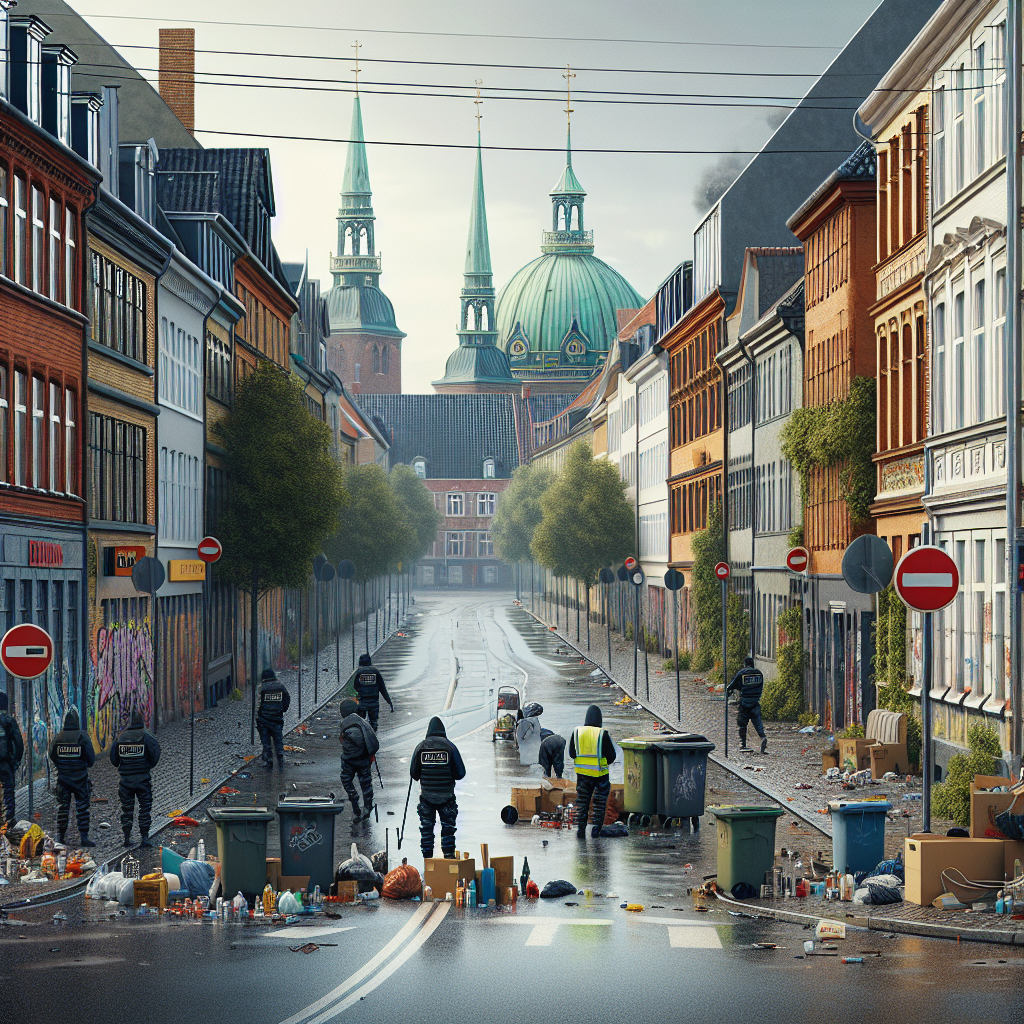
In Denmark’s notoriously rough ghettoes, where open drug use and the looming threat of violence are commonplace, podcaster Joe Fish finds a striking contrast: these areas are markedly cleaner than many urban centers in the UK.
Official UK government advisories caution travelers to exercise heightened vigilance when venturing into Copenhagen’s Christiania and Nørrebro districts, especially as night falls. Hotel staff often caution guests against visiting these areas altogether.
Even during daylight hours, places like Mjølnerparken, another entry on the Danish government’s infamous “ghetto list,” project an unsettling atmosphere. This designation highlights neighborhoods grappling with higher-than-average crime and unemployment rates, as well as lower levels of educational achievement, along with a significant proportion of first and second-generation migrants residing there.
Yet, Joe argues that even Copenhagen’s most troubled districts defy expectations, standing in stark cleanliness compared to comparable areas in the UK. “You wouldn’t even know that this is one of the worst areas in Copenhagen,” he remarked. “It’s not even comparable to the UK; it really isn’t.”
Having explored numerous economically depressed regions across the UK, Joe highlights the proactive role of local authorities in Copenhagen, which facilitate responsible waste disposal for residents.
Read more: Once-thriving beautiful seaside town plagued by thugs with machetes and drugs
Drug consumption room H17 in Vesterbro, Copenhagen (Image: YouTube / Joe Fish)
Joe noted, “You definitely don’t see large communal skips like this in England.” This, he argues, explains the absence of discarded rubbish, sofas, and mattresses cluttering UK streets.
While he observed men selling various items—likely pilfered—at street markets, he maintains that, on the whole, Copenhagen’s streets are far cleaner than their UK counterparts.
Despite the presence of some drug paraphernalia on Copenhagen’s inner-city sidewalks, Joe insists it’s significantly less than what you might encounter in cities like Birmingham or London. This cleanliness is partly attributed to the establishment of H17, a sprawling 1,000-square-metre drug consumption facility located in the Vesterbro district.
At this center, users can safely consume illicit drugs without fearing legal repercussions, all while medical staff are present to assist when necessary.
Danish ghettos are a lot cleaner than ours (Image: YouTube / Joe Fish)
Louise Runge Mortensen, the director of H17, elaborates, “Our nurses assist users by teaching correct injection techniques, cleaning wounds, screening for HIV and hepatitis, and providing overdose treatments.”
Reflecting on the situation, Joe mused, “I wonder what challenges this creates for the local community. While isolating drug use to specific areas might make policing it easier, it raises questions about the social implications.”
He further noted, “During my visits today, it was evident that drug use isn’t confined to just the sanctioned areas. I repeatedly witnessed open drug consumption in a few neighborhoods that tourists would likely avoid.”
Despite the controlled environment, Joe remarked on the palpable tension present on the streets, recalling a moment when he was confronted by an irate resident of a homeless camp, making clear his unwelcome presence. “You could almost feel the suspicion in the air,” he described. “And I had to keep an eye out for cyclists speeding along the pavements, showcasing yet another layer to navigating Copenhagen’s urban landscape.”
