

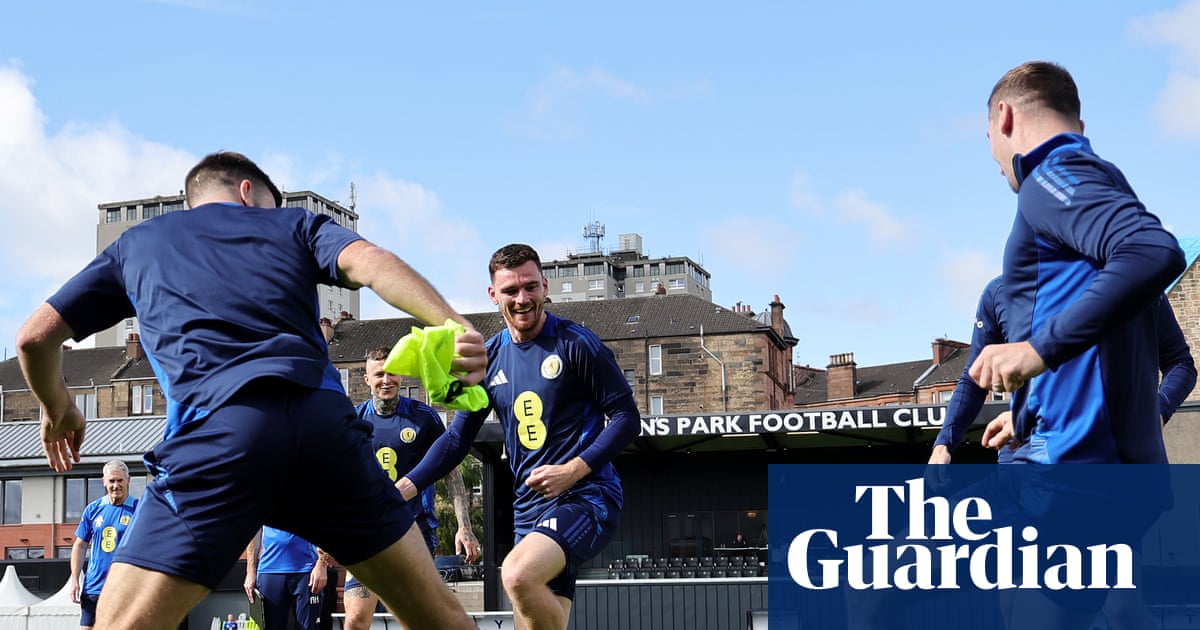
This week, the Scottish football community mourns the loss of Jimmy Bone, a man whose impact on the sport was profound. The robust forward’s sole goal for Scotland came during a memorable match at the original Parken Stadium in Copenhagen: Denmark 1, Scotland 4, in October 1972. At that time, under the brief stewardship of Tommy Docherty, Scotland was poised to break a 16-year World Cup drought.
This Friday, Copenhagen once again takes center stage, but the wait for Scotland has stretched to 1998. Since then, nations like Togo, North Korea, Panama, Saudi Arabia, and Wales have graced the World Cup without Scotland’s presence. Steve Clarke is on the cusp of becoming the longest-serving manager of the national team by match count. Meanwhile, the squad boasts a Ballon d’Or nominee in Scott McTominay, who, while representing Scotland, was actually born in England. As they embark on their journey towards the 2026 World Cup, six crucial games await.
Will this be Clarke’s slow march towards an exit, or will it be a confident stride into the annals of Scotland’s football history? The answer will unfold by November, as he has a mere 540 minutes to secure what would undoubtedly be the pinnacle of his managerial career. The magnitude of this challenge cannot be overstated.
It has become increasingly clear that Clarke intends to conclude his tenure—a journey that began in 2019—at the end of this World Cup cycle, which coincides with the expiration of his contract. The wisdom of this impending departure is debatable. The pressing question hanging over the 62-year-old’s head is whether he is leading a team that peaked too early, long before their disappointing showings in Germany and at the last Euros. While Scotland rallied during the later stages of their recent Nations League campaign, glaring weaknesses emerged, highlighted by home defeats to Greece and Iceland, where they conceded three goals in each match. Clarke’s puzzling public comments have only fueled discontent among the fans, who seem weary of the current status quo—especially with Greece, a burgeoning force, in the mix for this qualifying round.
The desire among Scotland’s supporters to see their team end this prolonged World Cup absence is palpable, and a successful return would bring a welcome splash of tartan to the tournament. Clarke’s achievements in raising standards are commendable, yet skepticism lingers. The enormity of the task ahead, beginning with Denmark on Friday, cannot be understated. When the time comes to find Clarke’s successor, the Scottish Football Association may find themselves in a state of panic, grappling with a dearth of standout talent available for selection. Recent transfer activities highlight a concerning trend of teams settling for uninspiring choices.
The situation in goal has reached a crisis point rather than a mere conundrum. Liam Kelly is sidelined at Rangers, Zander Clark’s time at Hearts seems limited, and Angus Gunn has hardly seen action since a brief appearance in the loss to Iceland in June. It’s likely Clarke will turn to Gunn against Denmark, a decision that offers little reassurance, given the keeper’s shaky performances in national colors.
Scotland’s central defense also raises concerns on the international stage. Although Andy Robertson’s status as a starter at Liverpool is in question, indicating a downturn in his form, Kieran Tierney’s return to Celtic has been beset by injury issues, leading to his withdrawal from the squad on Thursday. In the attacking line, players either lack experience (Kieron Bowie and George Hirst) or have struggled to find the net (Che Adams), leading to an over-reliance on the experienced Lyndon Dykes. There’s excitement surrounding young talent Ben Gannon-Doak, but at just 19, he has much to prove in the world of club football, as Clarke has often pointed out.
after newsletter promotion
Yet, amidst the uncertainty, there are flickers of hope. The return of Aaron Hickey, following a lengthy recovery from significant hamstring injuries, should ease concerns at right-back, a position where Scotland has been desperately searching for solutions. The midfield, led by McTominay, has proven more than sufficient for international competition, presenting Clarke with the challenge of accommodating an abundance of talent. History has shown that Scotland often thrives in tough away fixtures, relying on organization and grit, and even a draw in Copenhagen would be viewed positively as they prepare for a crucial match against Belarus on Monday evening in Hungary. Their last encounter with Denmark four years ago yielded one of Clarke’s finest victories, a 2-0 triumph.
In 1972, Scotland rode a wave of optimism, with legends like Billy Bremner, Martin Buchan, and Kenny Dalglish gracing the pitch. The defeat of Denmark then triggered a remarkable run, sending them to six of seven World Cups. As another chapter unfolds in Copenhagen, there are echoes of that era, yet the significant differences cannot be overlooked.
